




Managed PostgreSQL on AWS
Managed PostgreSQL® by Selfhost.dev, fully run for you.
Dedicated managed PostgreSQL instances on AWS, with point-in-time recovery, PgBouncer pooling, Multi-AZ standby, autoscaling, forking and full postgresql.conf control. Bring your own AWS account or run it in ours. Pay only for what you run and manage all of it from your AI editor.
The reliable home for your data.

Dedicated PostgreSQL, MySQL, Redis and ClickHouse on AWS, with BYOC into your own account. Multi-AZ on all four, PITR on Postgres and MySQL.
In our AWS account or your own with BYOC. You get AWS uptime and performance; we handle the ops.
Managed PostgreSQL pricing
Production Postgres,
from about $5/month.
There is no feature tier to unlock. PITR, PgBouncer, backups, Multi-AZ, users and roles, full configuration control, monitoring, alerts and all 189 MCP tools are available from the smallest instance.
Smallest configuration
t4g.nano on AWS Graviton
2 vCPU, 0.5 GB RAM, 1 GB data volume, plus the instance boot volume.
Welcome credit
$5
No card needed
ap-south-1 (Mumbai)
Smallest managed configuration
$5.34/mo
us-east-1 (N. Virginia)
Smallest managed configuration
$6.41/mo
A public IPv4 is assigned at deploy and adds about $4.93/mo. Your final price changes with region, compute, storage, replicas and network use and the review step shows the estimate before you deploy.
Prefer your own AWS account? BYOC keeps the infrastructure and AWS bill in your account, with Selfhost.dev management billed at the 70% management rate. No enterprise contract required.
See managed PostgreSQL in action
Empty form to live Postgres.
The complete creation and management flow.
Watch the five-step creation wizard, AWS provisioning and the running controls for backups, PgBouncer, database users, live metrics and alerts. Three chapters, self-paced.
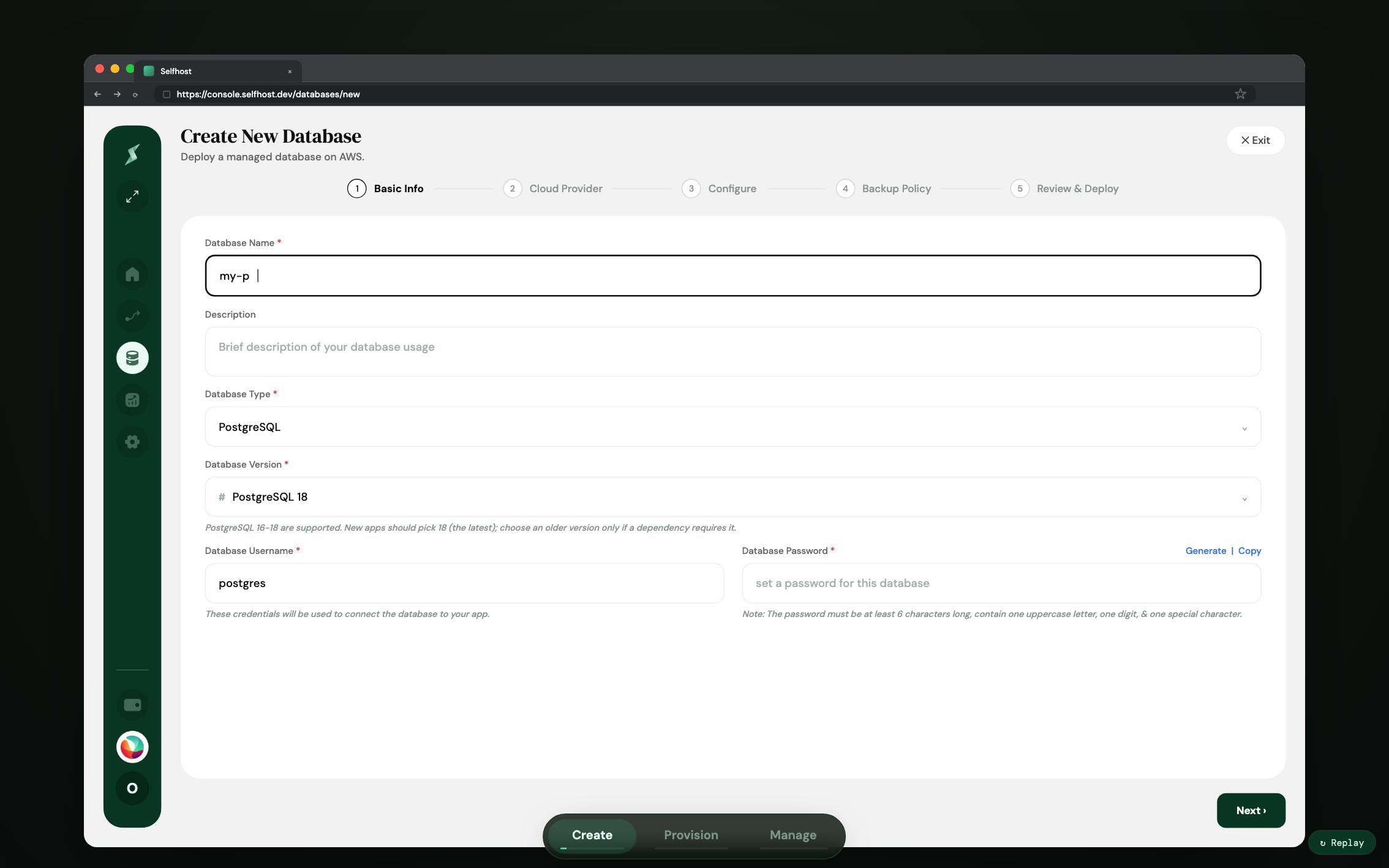
This walkthrough is built at desktop width and is best opened on a larger screen. Every chapter is written out below.
- 01 Create Choose PostgreSQL 16, 17 or 18, then set the AWS region, Graviton instance, storage, networking and backup policy before reviewing the exact cost.
- 02 Provision Watch the PostgreSQL instance come online with encrypted storage, automated backups, Multi-AZ standby and a connection string ready to copy.
- 03 Manage See PgBouncer pooling, point-in-time recovery and backups, database users and roles, live metrics and alert rules in the running console.
Limited time · Get $5 in free credit at signup
Run the same PostgreSQL flow for real.
Your $5 welcome credit runs the smallest managed PostgreSQL instance. No card is needed to start.
What you get
Everything managed PostgreSQL needs.
Nothing you have to babysit.
Instant provisioning
A 5-step wizard: basic info, cloud and region, instance size and storage, backup policy, review and deploy. Live in minutes.
Point-in-time recovery
WAL archived to S3, restore to any second into a fresh instance. No tier fee, you pay only WAL storage at $0.03/GB.
Connection pooling
PgBouncer on port 6432 with transaction, session and statement pool modes. Included, no separate proxy to bolt on.
Multi-AZ high availability
A standby in a second availability zone with automatic failover, for production resilience without manual setup.
Backups and policies
Manual snapshots plus automated backup policies with the retention you choose. Restore on demand.
Forking
Spin up a fully independent copy of a database for testing, staging or analytics without touching production.
Autoscaling, scheduled or reactive
Resize on demand, set reactive autoscaling rules that follow load or schedule start, stop and scale windows so you pay for capacity only when you use it.
Full config control
Tune shared_buffers, work_mem, max_connections and every other parameter. No locked-down parameter groups.
Users, roles, monitoring
Database users with read-only, read-write or admin roles and password rotation, plus live metrics and email and Slack alerts.
Vector search with pgvector
Enable the pgvector extension for embeddings and similarity search, the foundation for semantic search and RAG. Learn about vector databases.
Time-series with TimescaleDB
Enable the TimescaleDB extension for hypertables, compression and continuous aggregates, a time-series database inside Postgres. Learn about time-series on Postgres.
Encrypted in transit and at rest
Connections use TLS and your data is encrypted at rest on EBS with AWS KMS keys, so snapshots and backups are encrypted too.
Limited time · Get $5 in free credit at signup
Put the PostgreSQL control surface to work.
Provision a dedicated AWS instance with backups, pooling, monitoring and full configuration control available from the start. No DBA or higher feature plan required.
Your data: encrypted, isolated,
and always under your control.
Security is not a separate tier here. Every managed instance ships locked down by default, encrypted end to end and yours to export or run in your own cloud.
See how we secure and run your dataEncrypted in transit and at rest
TLS on the wire, AWS KMS on disk. Snapshots and backups are encrypted too.
Single-tenant, dedicated instance
Your own dedicated instance, not a shared multi-tenant database pool.
Private by default
IP whitelisting and delete protection are on. Public access only if you turn it on.
Multi-AZ, PITR and backups
Automatic failover on every engine, point-in-time restore on PostgreSQL and MySQL, automated backups on all.
Your data stays yours (BYOC)
Run it in your own AWS account. Standard engines, nothing proprietary, yours to keep.
Benchmarked, not hand-wavy
Fast and proven in the open.
Full durability on, no special tuning.
Real pgbench numbers on AWS, with production durability settings and zero errors across every run. Not a cherry-picked demo. 250+ developers have signed up to run their databases on Selfhost.dev.
*Compared with an equivalent AWS RDS instance; RDS price estimated.
Bring your own cloud
Our management.
Your AWS account.
Run managed PostgreSQL inside your own AWS account with BYOC. You keep full ownership of the infrastructure, the VPC and the data residency, while Selfhost.dev handles provisioning, backups, failover and upgrades at a 70% management rate. New to the model? Here's what BYOC is and when it makes sense.
- ✓ Connect via access keys or an IAM role
- ✓ Your VPC, your security groups, your region
- ✓ No enterprise contract required
Pay-as-you-go. You see the AWS rate and our fee, math you can verify. Build your exact bill.
AI-native management
Manage Postgres with AI.
Right from your editor.
Create instances, run backups, tune parameters, configure alerts and inspect performance from Claude, Cursor, Windsurf or any MCP client. 189 MCP tools across 31 modules, every one mapped to a real API call, with destructive operations gated behind explicit confirmation.
How it compares
Cheaper than RDS.
More control than a PaaS.
Same Graviton hardware as RDS for far less than RDS's ~93% markup over raw compute, with PITR, pooling and BYOC included. See the real numbers, side by side. And read why RDS gets expensive as you grow.
Pick by the job
Two ways to run PostgreSQL
on Selfhost.dev.
When the database is the thing
A dedicated instance on AWS that has to stay up, scale and recover and that any app can point at, wherever it runs. This is the full control surface: PITR to any second, PgBouncer pooling, Multi-AZ, autoscaling, forking, pgvector and TimescaleDB, users and roles, alerts and postgresql.conf control.
When it ships beside your app
A Project is Selfhost.dev's managed application hosting: a server we run where you deploy apps from GitHub. Add PostgreSQL to it in one click (pgvector optional) and it lives on the same server as your code, billed with the server by the hour. Right for dev stacks and apps that want their database next door.
Both are provisioned and run for you. The managed instance carries the production machinery (point-in-time recovery, pooling, failover, per-database users and alerts); the Project database trades that depth for one-click simplicity next to your code. Many teams run both, on one bill.